
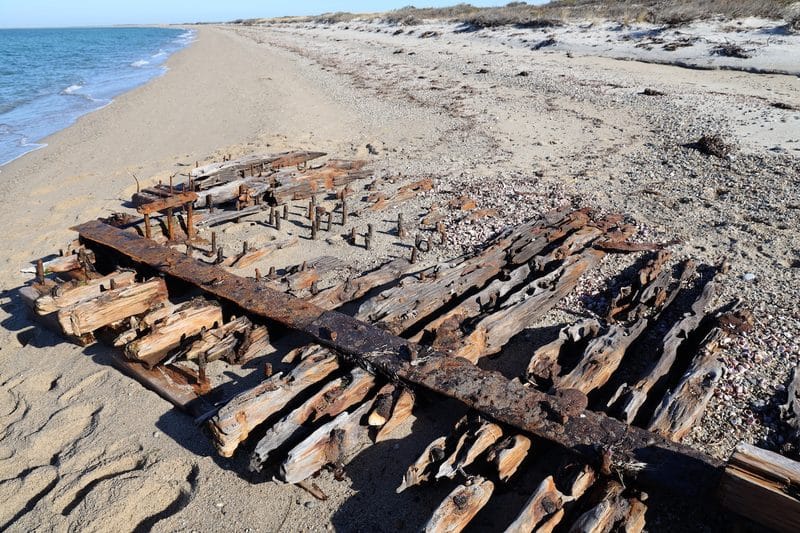
On Friday, November 20, 2026 Egan Maritime staff members explored Coatue Beach to examine what they believed were shipwreck remains. These remains were reported to our organization after the fall nor’easter.
The purpose of this expedition was to conduct a preliminary assessment of fragments to submit a SHIPS (Shoreline Heritage Identification Partnerships Strategy) report to the Board of Underwater Archaeological Resources (BUAR).
After this initial assessment, our team believes the fragments may belong to a schooner barge. These were sailing schooners either converted or built to be towed by steam tugs. They had smaller crews and could carry optional sails while hauling bulk goods such as coal and stone. Schooner barges passing Nantucket Island mainly traveled the Atlantic coastal trade corridor between Mid-Atlantic coal ports and New England industrial hubs. Primarily active from the 1870s through the 1930s, they were often older wooden schooners with reduced rigs, towed in strings of two to four behind steam tugs.
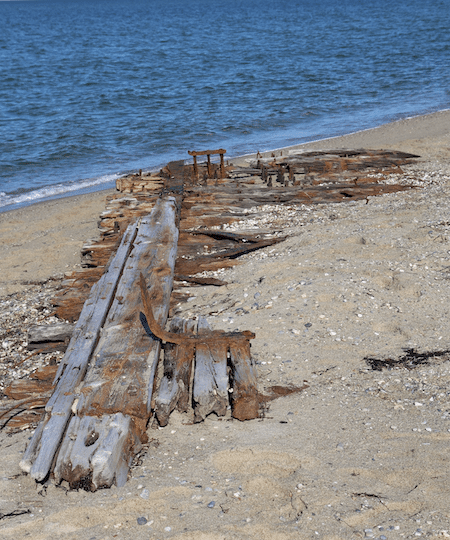
In addition, wreck fragments were sighted elsewhere on Coatue Beach. These fragments measured around 108 feet long and were much more inland than the other remains found that day. Egan is working to bring David Robinson, president of BUAR (Board of Underwater Archaeological Resources), back to the Island to further assess both wreck sites and to STAMP them through the Shipwreck Tagging Archaeological Management Program (STAMP). Through STAMP, the public can help archaeologists document and monitor shipwreck sites and track shipwreck timbers separated and redeposited along the coast.
Egan Maritime is grateful to members Harvey and Ellen Young for accompanying the two staff members on the beach and for their valuable input. Members of the public are reminded to avoid disturbing the wreck site and to report any additional findings to Egan Maritime Institute.
Egan Maritime Institute promotes and preserves Nantucket’s maritime traditions, striving to ensure that the island’s culture and community continue to be shaped by its seafaring legacy. Founded in 1989 by Albert F. “Bud” Egan, Jr. and Dorothy H. Egan, the Institute achieves its mission through programs in the classroom, at the Shipwreck & Lifesaving Museum, and on the water aboard the tall ship Lynx. Learn more at eganmaritime.org.